Where are you on the nature connectedness scale?
Are you and nature one and the same, or are you, as a member of the human race, completely separate? Your answer will help determine where you fall on the connectedness to nature scale, the most common visual iteration of which is taken from the Inclusion of Nature in the Self (INS) scale, presented below, from Beery et al. (2024) (to find more about the different scales used, click here).
Take a moment to reflect on where you see yourself…
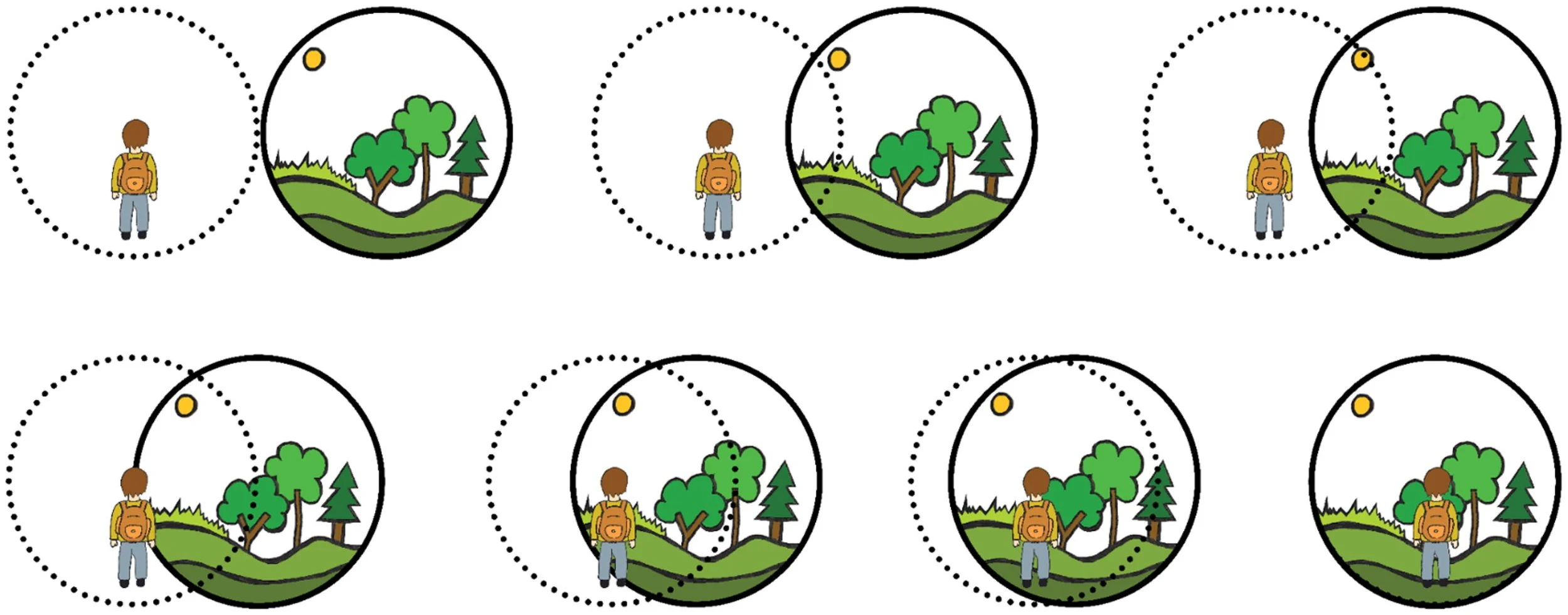
So, what was it that informed your answer? If you are passionate for nature but avoided giving yourself a full overlap because you aren’t literally Tarzan, dirt beneath your fingers and living in trees, you wouldn’t be alone, but you’d also be making a common incorrect assumption. A high connection to nature is more about the perception of our environment than it is our lifestyle (though, an eco-conscious way of living is strongly correlated - more on that later!), talking to Gorillas is just a bonus.
Think of it this way, those who give themselves a low nature connection score will see two different spheres: ‘us’ - humanity and culture, and ‘them’ - the natural world. True nature connectedness comes when you do not perceive there to be a definitive distinction between ‘us’ and ‘them’, where the boundaries of humanity and the environment we live in are so blurred they are inextricable from each other. If it helps, the analogy is easily applied to many ‘us’ and ‘them’ puzzles, there is almost no limit to what we can ‘other’ if we put our blinkers on narrow enough.
For me, it’s all about feeling the inherent interconnection between the life giving systems around us. Maybe Pocahontas is the better Disney character to liken Nature Connectedness too - indeed true indigenous land relationships are a great discussion.. for another blog. But the poetry in ‘colours of the wind’ paints (!) the importance of an emotional rather than transactional view of the land, ‘the Earth is just some dead thing you can claim’, an incredible summation of the commodification of nature that separates us from it. The story of this connection emphasises relationality, where land is not a resource or a backdrop to our separate lives, but in itself a living teacher, a source of identity, kin.
The best part is, high nature connection levels are not at all correlated to high education levels. There’s no need to know how many carbon parts per million there are lingering in our atmosphere to feel the benefits of a lungful of fresh green air, and there’s plenty of strong evidence to show that our bodies inherently know what’s good for us - forest bathing anybody? There are also several subjectively positive traits that tend to co-exist with Nature Connectedness that may lead to increased curiosity:
Prefer spending time outdoors
Higher levels of pro-environmental behaviour (Anderson and Krettennauer, 2021)
Higher levels of empathy
Greater emotional resilience
Greater ability to understand interconnection (Martin et al, 2020; Lengieza, 2024)
Stronger creative thinking and problem-solving ability
Personality traits such as: agreeableness, conscientiousness, and openness (Capaldi et al., 2014)
Naturally, higher education about climate issues may help channel all these positive traits, and give that pro-environmental behaviour the knowledge it needs to make a difference.
With all of this, I keenly anticipate that you’re crying out for knowledge on how to increase your own Nature Connection (or that of those you know), well, I’ve got you covered. Frameworks exists that can help dismantle false ‘dualities’ and thus create a toolkit for nature connection - Teach for Earth leads with this to share 6 approaches you can use in your life to help connect you to nature. They’re so powerful they can even be used indoors! Click here to learn more, and then go take 5 minutes outside…
Anderson, D.J. and Krettenauer, T., 2021. Connectedness to nature and pro-environmental behaviour from early adolescence to adulthood: A comparison of urban and rural Canada. Sustainability, 13(7), p.3655.
Beery, T., Friedberg, M., Praestholm, S., Winsche, T., Bolling, M. (2024) Connectedness to nature: a tale of three scales, Environmental Education Research. Available at: https://doi.org/10.1080/13504622.2024.2320342.
Capaldi, C.A., Dopko, R.L. and Zelenski, J.M., 2014. The relationship between nature connectedness and happiness: A meta-analysis. Frontiers in psychology, 5, p.92737
Lengieza, M.L., 2024. Eudaimonic self-expansion: The effects of eudaimonic reflections on nature connectedness. Journal of Environmental Psychology, 94, p.102231
Martin, L., White, M.P., Hunt, A., Richardson, M., Pahl, S. and Burt, J., 2020. Nature contact, nature connectedness and associations with health, wellbeing and pro-environmental behaviours. Journal of environmental psychology, 68, p.101389